5 Hidden Features of the Geekom It15 Mini Pc You Must Know About
The Geekom It15 Mini Pc is positioned as a compact, high-value desktop replacement for users who need capable performance without the bulk. Beyond the spec sheet and marketing blurbs, the It15 hides several practical features that can materially change how the machine fits into real-world workflows—from home offices and media centers to small business edge deployments. This article explores five of those lesser-known capabilities, explains why they matter, and helps buyers decide which configuration and accessories make the most sense for their use.
Introduction: Why “hidden” features matter for mini PCs
Mini PCs are judged by size, raw performance, and price, but practical day‑to‑day experience is shaped by smaller, often overlooked details: upgrade paths, thermal and fan controls, connectivity versatility, and remote management tricks. For buyers who prioritize longevity, quiet operation, or multi‑monitor setups, these subtleties determine whether the device becomes a lasting part of a workflow or a short-lived experiment.
This article focuses on five specific capabilities of the Geekom It15 Mini Pc that owners often discover only after purchase. Each section explains the feature, how to use it, typical use cases, compatibility caveats, and whether it’s worth prioritizing when choosing a configuration.
Hidden Feature 1 — Dual-storage flexibility: NVMe speed plus SATA capacity
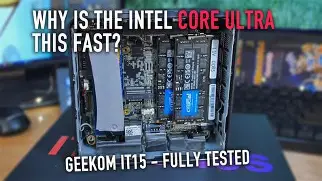
One of the most valuable but underappreciated features in many modern mini PCs is the ability to run both a high-speed NVMe SSD and a larger 2.5" SATA drive simultaneously. The Geekom It15 often exposes this flexibility through an internal M.2 slot for the operating system and an internal 2.5" bay (or a second M.2 slot on some configurations) for mass storage.
Why it matters
Users typically want a fast OS and app drive plus roomy storage for photos, videos, VM images, or game libraries. A single NVMe-only setup forces compromises (small capacity or higher cost). The dual-storage approach keeps the OS and critical apps on the NVMe for responsiveness while placing bulk data on the SATA or secondary M.2.
Real-world use cases
- Content creators who edit 4K footage can keep scratch disks on the NVMe while archiving completed projects on the 2.5" drive.
- Small business desktops can host the OS plus a local database on NVMe, with backups and logs on the larger SATA disk.
- Home theater builders can run the media center OS on the NVMe and store a media library on the larger drive.
Buyer tip: Confirm whether the specific It15 configuration includes the 2.5" caddy or second M.2 and whether a SATA power connector is pre-wired. If not, plan for a small internal adapter or select a configuration that ships with both.
Hidden Feature 2 — User-accessible dual-channel RAM and upgradeability
Mini PCs sometimes arrive with soldered RAM; others offer two SODIMM slots that support dual-channel memory. The It15 typically favors the latter design, enabling straightforward RAM upgrades and dual-channel operation for better integrated GPU performance and multitasking.
Why dual-channel matters
Integrated graphics and memory-hungry applications benefit significantly from dual-channel memory: improved bandwidth translates into smoother video playback, faster data processing, and better responsiveness when running multiple apps or VMs. The ability to upgrade RAM without replacing the entire unit extends the device’s useful life.
Real-world use cases
- Remote workers who run multiple browser windows, conferencing, and local VMs should target at least 16 GB in dual-channel to avoid swap thrashing.
- Developers running light local containers will see a measurable improvement when moving from single-channel 8 GB to dual-channel 16 GB.
- HTPC users who want to transcode streams will benefit from faster integrated GPU memory throughput.
Buyer tip: When selecting memory, buy matched SODIMM pairs to ensure true dual-channel operation; check the maximum supported capacity in the manual so upgrades avoid compatibility surprises.
Hidden Feature 3 — Built-in multi-display support and flexible display mapping
Compact systems like the It15 often support three simultaneous displays via a mix of HDMI, DisplayPort, and USB-C (DisplayPort Alt Mode) outputs. This is a major hidden strength for productivity and digital signage applications.
Find top-rated Laptops & Computers products at great prices.
See Deals →Why multi-display capability is useful
Many buyers assume a small chassis means limited screen outputs. In reality, modern mini PCs can drive 2–3 monitors at 4K or a combination of 4K + lower-resolution panels depending on GPU bandwidth and the specific port mix. This capability turns the It15 into a full-featured workstation for spreadsheets, trading, control rooms, or creative timelines.
Real-world use cases
- Financial or analytical workflows often need 2–3 monitors to compare data, charts, and communication tools simultaneously.
- Creative pros can dedicate one display to a timeline, another to preview, and a third to assets or tool palettes.
- Businesses deploying digital signage or kiosks can use the It15 to power multiple outputs from a single low-footprint box.
Buyer tip: Confirm the native maximum resolution and refresh rate per output in the technical documentation and whether any outputs share bandwidth. For specialized setups, test extended-display and rotation configurations before final deployment.
Hidden Feature 4 — Quiet mode, fan curves, and thermal tuning in firmware
Mini PCs frequently expose firmware-level fan and power profiles that allow users to tune behavior for silent operation, balanced performance, or sustained performance depending on workload. The It15 commonly includes these options in the BIOS/UEFI or via a bundled utility, enabling much better acoustic control than many buyers expect.
Why thermal tuning matters
Small enclosures can heat up under load, leading to throttling or audible fans. Having the ability to prioritize silence or performance helps tailor the device to the installation environment: a living room HTPC needs near-silent operation, while a studio workstation may accept louder fans for higher sustained performance.
Real-world use cases
- Living-room media centers benefit from a quiet mode that keeps the fan nearly inaudible during video playback.
- Office desktops can use a balanced profile to reduce noise during simple tasks and allow bursts of fan activity only when needed.
- Edge or server-like deployments can select aggressive thermal profiles to ensure consistent CPU performance under long-running loads.
Buyer tip: If silence is critical, test the device in the target environment because ambient room noise and placement (enclosed cabinet vs. open shelf) change perceived acoustics. Also check whether the vendor utility runs under the chosen OS or only under Windows.
Hidden Feature 5 — Wake-on-LAN, BIOS power scheduling, and remote management tricks
Beyond physical I/O and internals, the It15 hides useful remote management features: Wake-on-LAN (WoL), BIOS-level scheduled power-on/off, and Wake-on-USB. These are particularly useful in business or home-lab contexts where the mini PC must be reachable remotely or operated on a schedule.
Why remote power features are important
Small machines are often used as always-on appliances — NAS frontends, media servers, or lightweight gateways. Being able to wake the machine remotely (WoL) or schedule automatic power-on eliminates the need for physical interaction and reduces power draw when the device is not needed.
Real-world use cases
- Small offices can schedule non-business-hours shutdowns and morning start-ups to save energy without manual intervention.
- Home labbers can wake the mini PC remotely to run nightly builds or backups, then have it sleep again.
- Remote support teams can restart or boot a client machine with secure WoL tools for troubleshooting without on-site visits.
Buyer tip: Verify motherboard/BIOS support for WoL and whether the Ethernet port or Wi‑Fi adapter supports wake-from-sleep. Secure the WoL setup with network segmentation or VPN access, because WoL packets can be a vector for unwanted wake events on exposed networks.
Detailed product analysis: performance, thermals, ports, and real-world behavior
The practical value of the Geekom It15 Mini Pc comes from how these features interact with daily usage. This section synthesizes performance expectations, thermal behavior, port layout, and the kind of maintenance owners should expect.
Discover deals on Laptops & Computers — updated daily.
Browse Now →Performance and configuration options
The It15 positions itself as a general-purpose mini PC suitable for productivity, light creative work, and media playback. Buyers should expect reasonable multi-core CPU performance for office workloads and efficient single-core speeds for general responsiveness. Integrated graphics are adequate for video decoding, light photo editing, and casual gaming at modest settings.
Thermals and sustained loads
Small chassis mean thermal design is a compromise. Under short burst workloads the It15 can hit solid performance, but very long sustained loads (rendering large video projects or heavy compilation) will cause thermal throttling unless the configuration uses an aggressive cooling profile. Firmware fan control and placement—avoid enclosed cabinets—make a substantial difference.
Ports and expansion
Port variety is a strength for versatile mini PCs. The It15 generally includes multiple USB-A and USB-C ports, at least two display outputs, Gigabit Ethernet, and audio jacks. The availability of an internal 2.5" bay or extra M.2 is the key expansion advantage many users miss on first inspection.
Software and OS compatibility
Windows is the common shipping OS with vendor utilities for power and fan tuning. Linux compatibility is good for mainstream distributions, but check specific Wi‑Fi and Bluetooth chips for driver availability. Virtualization features (Intel VT‑x/VT‑d) make the device respectable for lightweight VM use, provided the user allocates sufficient RAM and uses fast storage.
Pros & Cons
- Pros
- Compact footprint with strong port selection for multi-monitor setups.
- User-upgradable RAM and storage in many configurations.
- Helpful firmware options for fan and power management.
- Practical remote management features like Wake-on-LAN and scheduled power.
- Dual-storage flexibility useful for media and business use cases.
- Cons
- Small chassis can lead to thermal throttling under prolonged heavy loads.
- Not all configurations include all upgrade components (confirm 2.5" caddy, extra M.2, RAM installed).
- Vendor utilities may be Windows‑only, reducing convenience for Linux users.
- Internal access for upgrades requires basic disassembly; check warranty terms before opening the case.
Comparison table: Geekom It15 vs. typical mini PC alternatives
| Category | Geekom It15 | Intel NUC (typical) | Minisforum Elite Mini (typical) |
|---|---|---|---|
| Upgradability | Good — SODIMM slots, NVMe + possible 2.5" bay | Varies — some models solder RAM, others SODIMM | Good — often SODIMM + dual storage options |
| Port variety | Strong — multiple video outs, USB‑C, Ethernet | Solid, but depends on SKU | Strong — similar to It15 |
| Thermals | Balanced — can throttle under long heavy loads | Well-optimized on some models | Often similar tradeoffs; models exist for higher thermal budgets |
| Value | High — competitive for features per dollar | Premium on branded models | Comparable to It15; depends on sales/region |
| Ideal use | Home office, HTPC, lightweight workstation | Business desktops, premium compact builds | Power users, compact gaming, workstations |
Buying guide: choosing the right It15 configuration
When choosing an It15, prioritize choices based on intended use. The following checklist helps align configuration options with workload requirements and long-term value.
Checklist for buyers
- Primary use: Office and browsing vs. media center vs. light content creation — pick CPU and RAM accordingly.
- RAM: Aim for 16 GB dual-channel for most users; 32 GB+ for heavier multitasking, VMs, or editing.
- Storage: NVMe for OS and apps; add a 2.5" SATA or secondary M.2 for bulk storage if media or large datasets are expected.
- Ports: Confirm the number and type of video outputs required for your monitor setup and whether USB‑C supports DisplayPort Alt Mode.
- Thermals & noise: If silence matters, test in a similar environment or prioritize configurations with better cooling and firmware quiet profiles.
- OS compatibility: Check driver support if planning to run Linux or alternative OSes; Wi‑Fi and Bluetooth chips can be a gotcha.
- Warranty & service: Understand the vendor warranty and whether opening the case voids it before planning upgrades.
Recommended configurations by use case
- Home office: Core i5-level CPU, 16 GB RAM, 512 GB NVMe. Dual displays, gigabit Ethernet, and quiet firmware profile.
- Media center/HTPC: Lower-power CPU for silent operation, 8–16 GB RAM, NVMe for OS, 2.5" HDD or large SATA SSD for media library, and VESA mount for behind-TV placement.
- Light creative work / developer: Higher-core CPU option, 32 GB RAM preferred for VM work, dual-storage for project scratch and archive, balanced fan profile.
- Small business/edge use: Focus on reliable networking (Ethernet), WoL/Bios scheduling for remote operation, ECC not typically available so rely on backups.
Conclusion
The Geekom It15 Mini Pc is more than a compact box; it’s a flexible platform whose full potential reveals itself in the details. Dual-storage options, user-accessible dual-channel RAM, comprehensive display outputs, firmware-based thermal tuning, and remote power features are the kinds of capabilities that change how the device is used in real life. These are the hidden features that make the difference between a short-term desktop and a versatile tool for home offices, media centers, and small business deployments.
Buyers should match a configuration to their primary use, confirm which upgrade components are included, and test power and acoustic profiles in the intended environment. With the right choices, the It15 can be a silent background workhorse or a compact, powerful hub for a multi‑monitor productivity setup.