Kodak Ektar H35N Specs, Features, and Value: Is it worth the price tag?
Category: Cameras
Introduction
The Kodak Ektar H35N is a compact, half-frame 35mm film camera that revived interest in affordable, creative analog photography when it appeared on the market. Positioned as a simple, fun device rather than a technical workhorse, the H35N delivers a blend of retro styling, a glass-containing coated lens, and a few small conveniences—built-in flash, bulb mode, and a star filter—while retaining the “point-and-shoot” simplicity many buyers expect. This article examines the camera’s specifications, how it performs in real-world situations, who should consider one, and whether its feature set justifies the price relative to alternatives.
Official specifications (summary)
The following list consolidates the camera’s key technical points as reported by official materials and hands-on reviews:
- Film format: 35mm, half-frame (image size approx. 18 x 24 mm; doubles typical exposures per roll)
- Lens: Fixed wide-angle 22 mm (coated two-element construction: one glass element + one aspherical acrylic)
- Aperture: Fixed (commonly referenced as f/8; some reviewers note effective variations around f/11 under default daylight conditions and f/8 when flash is used)
- Shutter: Fixed-speed 1/100 s; bulb mode available for long exposures
- Focusing: Fixed-focus / focus-free design (minimum focus distance around 1 meter)
- Flash: Built-in manual flash (turn on when needed)
- Battery: Single AAA battery required only to power the flash; camera operates mechanically without battery if flash is not engaged
- Special features: Built-in four-point star filter (for highlight starbursts), tripod socket, manual film advance and rewind, no metering or autofocus
- Release: Launched in the mid‑2020s (widely reported as introduced in 2023)
Product review and in-depth analysis
Design and build
The Ektar H35N adopts a compact, retro-inspired silhouette with simple controls and a light feel that makes it easy to carry for days when discretion is important. Build quality is consistent with inexpensive, consumer-focused film cameras—plastics and lightweight metals where needed—aimed at portability rather than rugged, professional use. The control layout favors minimalism: a shutter button, a small flash on/off switch, a film rewind knob, and a tripod mount for long exposures. For buyers who prioritize pocketability and a no‑fuss shooting experience, the H35N’s design ticks the right boxes.
Optics and image character
Where the H35N stands out from many ultra-cheap throwaway compacts is the inclusion of a coated two-element lens with at least one glass element. That construction generally translates to improved sharpness, better contrast, and fewer aberrations versus all-plastic optics. The fixed wide-angle 22mm focal length on a half-frame format provides a field of view roughly equivalent to a moderate-wide angle on full-frame, which suits travel, street, and environmental portraiture when the half-frame crop is taken into account.
The fixed aperture and shutter limit technical control, but they also produce a consistent, film-like rendering that many users find charming. The built-in star filter offers a stylized effect on highlights—useful for creative shots of city lights or specular reflections—while the coated elements help keep colors and contrast pleasing under most daylight conditions.
Exposure, focusing, and low-light behavior
The Ektar H35N is intentionally simple: there is no meter or variable exposure control. The fixed shutter speed (1/100 s) and fixed aperture mean exposure decisions are essentially set by the camera, leaving the photographer to choose film ISO and whether to use flash. This approach simplifies operation but places constraints on technique. The camera handles daylight well and yields reliable results with typical color negative and slide stocks within common ISO ranges, but results in very bright sun or deep low light can vary depending on film choice and creative intent.
Fixed-focus design eliminates autofocus failures but forces photographers to accept a “zone” focusing compromise. Subjects closer than the minimum focus distance (around 1 m) will not be critically sharp. For candid street work, landscapes, and group shots, fixed focus is usually adequate, but portrait work that requires tight background separation or extreme close-ups is not the H35N’s strong suit.
Flash, battery, and practical shooting considerations
The built-in flash is manual—it must be switched on—and draws power from a single AAA battery. Because the camera itself is mechanically capable of operating without power, battery dependency only becomes an issue for low-light situations that require flash. The inclusion of a tripod socket and a bulb mode is a practical bonus: it allows for long exposures when the camera is stabilized, expanding creative possibilities beyond the fixed shutter speed.
Looking for the best Cameras & Photography deals on Amazon?
View Offers →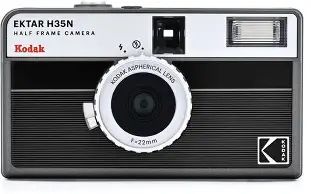
Half-frame advantages and trade-offs
Half-frame format is perhaps the H35N’s most prominent selling point. By capturing two frames in the area normally occupied by one standard 35mm frame, photographers effectively double the number of exposures per roll—an economical advantage for experimenting, travel diaries, and snapshot-oriented workflows. The trade-off is smaller negatives, which can reveal more grain and offer less latitude when enlarging or pushing scans for large prints. For photographers who scan and share images online or prefer contact-sheet–style storytelling, half-frame is a compelling format. For those aiming for large, high-resolution prints, full-frame 35mm or medium format cameras remain preferable.
Pros & Cons
Pros
- Simple, pocket-friendly camera ideal for casual shooting and travel
- Coated two-element lens (including a glass element) that produces better image quality than many plastic-lens compacts
- Half-frame format doubles exposures per roll—economic and encourages creativity
- Built-in star filter and bulb mode add creative options beyond typical toy cameras
- Operates without battery (flash optional), which is convenient for field use
Cons
- Fixed focus and fixed exposure limit technical control and versatility
- No metering—exposure is largely determined by film choice and lighting; tricky lighting conditions require planning
- Smaller half-frame negatives limit large print potential and increase visible grain at higher ISOs
- Plastic-forward construction means less durability than higher-end compact film cameras
- Not suited to macro or close-focus portrait work due to minimum focus distance
Comparison: where the H35N sits in the market
The H35N occupies a niche between ultra-basic plastic disposables and higher-end glass-lens compacts. The following table compares the H35N against broad categories of competitors to help buyers weigh trade-offs.
| Feature | Kodak Ektar H35N | Cheap plastic compact / Disposable | Glass-lens point-and-shoot (vintage) |
|---|---|---|---|
| Film format | 35mm half-frame | 35mm full-frame | 35mm full-frame |
| Lens | 22mm coated 2‑element (glass + aspheric acrylic) | Plastic single- or two-element | Multi-element glass lens (better sharpness) |
| Aperture / Shutter | Fixed aperture (approx. f/8–f/11) / 1/100 s, bulb | Fixed, variable by design (often wide aperture) / variable | Variable aperture and shutter or multiple speeds; often automatic exposure |
| Focus | Fixed-focus (focus-free) | Fixed-focus | Autofocus or zone-focus (better close-focus performance) |
| Flash | Built-in manual flash (battery: AAA) | Built-in flash (battery integrated / single use) | Built-in or external hot shoe, stronger flash options |
| Creative features | Star filter, bulb, tripod socket, half-frame storytelling | Minimal; often gimmicky filters if any | Generally higher optical quality; some models include aperture control, zooms, etc. |
| Best for | Travelers, beginners, experimenters, daily shooting | One-off events, very low budget, throwaway snapshots | Enthusiasts seeking higher image quality without a SLR |
Buying guide: what to consider before purchasing
When evaluating whether the Ektar H35N is the right purchase, potential buyers should weigh a handful of practical factors beyond the headline specs.
1. Intended use and workflow
Consider how the camera will be used. The H35N is ideal for travel journals, street snapshots, and projects where doubling exposures per roll is an advantage. It fits a photographer who values storytelling and experimentation over technical control. If the buyer prioritizes large prints, precise exposure control, or macro portraits, this camera is not the optimal choice.
2. Film choices and scanning
Half-frame images are smaller; they look best when scanned at sufficient resolution or shared online. Buyers should be willing to scan negatives or pay for lab scans if they want crisp digital files. Film selection matters: lower-ISO films will produce less grain and better color fidelity on small negatives, while higher-speed films increase flexibility in low light but emphasize grain.
3. Lighting and exposure expectations
Because the camera lacks metering and variable exposure, it is most reliable in consistent daylight and controlled indoor scenes with flash. Buyers who frequently shoot mixed lighting, backlit scenes, or night interiors should anticipate a learning curve or supplemental techniques (flash, tripod + bulb exposures).
4. Durability and build quality
If frequent outdoor use in rough conditions is planned, assess build quality and handling. The H35N is lightweight and portable but not engineered for heavy abuse. Consider protective cases or straps and remember that repairs for inexpensive consumer film cameras are often not cost-effective.
5. Value relative to alternatives
Compare the H35N to secondhand glass-lens compacts and other half-frame options. A used vintage point-and-shoot with autofocus and better exposure control may sometimes be available in the same price bracket. Conversely, the H35N’s combination of a glass element and half-frame format could be more appealing for those seeking a modern production run and guaranteed spare parts or warranty support.
Find top-rated Cameras & Photography products at great prices.
Browse Now →6. What to check on arrival
- Confirm the camera advances and rewinds film smoothly and that the shutter fires reliably.
- Test the built-in flash with a fresh AAA battery if low-light shooting is important.
- Check the star filter mechanism (if accessible) and tripod socket for secure mounting.
- Run a test roll to verify focus performance at various subject distances and to get a feel for the lens character.
Real-world use cases and buyer concerns
Many buyers choose the H35N for travel photography where packing light and shooting frequently are priorities. The ability to record twice as many frames per roll makes it attractive for long trips or events. Street photographers who favor candid imagery also appreciate the no-friction approach: load film, set flash if needed, and concentrate on composition.
Hobbyists and educators find the camera useful for teaching film basics—load a roll, shoot in different lighting, then examine negatives and scans to learn about exposure, grain, and framing. The star filter and bulb mode give extra creative avenues for photographers who want to experiment without investing in complex equipment.
Common buyer concerns include the lack of metering and variable exposure, fixed focus limitations for close work, and the smaller negative size that constrains large prints. Film cost, lab processing, and scanning are recurring practical considerations as well—half-frame doubles exposures per roll, which helps control per-image film cost, but scanning small negatives at high quality still costs time or money.
Is it worth the price tag?
Answering whether the Kodak Ektar H35N is “worth it” depends on expectations and use cases. For photographers seeking a modern, easy-to-use half-frame camera with better-than-plastic optics, creative features like a star filter, and a compact travel-friendly body, the H35N represents strong value. It occupies a sweet spot for experimentation and everyday shooting: it is more satisfying optically than a disposable and more playful in format than a typical full-frame point-and-shoot.
However, for photographers who demand technical precision—variable shutter speeds, reliable autofocus, metering, close-focus capability, or large print potential—there are better options in vintage used markets or higher-end contemporary compacts. Those buyers will find the H35N’s fixed settings limiting.
Conclusion
The Kodak Ektar H35N is a purpose-built, affordable film camera that emphatically leans into simplicity, creativity, and the economy of half-frame shooting. It will appeal to travelers, experimenters, and beginners who want a lightweight camera with a glass-containing lens and a few playful features. Its limitations—fixed focus, fixed exposure, and smaller negatives—are not hidden; they are inherent to the camera’s design and part of its character.
In short, the H35N is worth the price for those who value its specific combination of portability, image character, and half-frame efficiency. For users who need broader technical control or large, gallery-quality prints, alternative cameras should be considered. Prospective buyers should assess shooting goals, handle a test roll, and factor in film and scanning workflows before deciding whether the H35N fits their photographic practice.